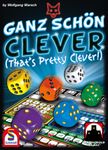
Ganz Schön Clever
BoardGameGeek link
Details
Sourced from: https://jmo.name/games
Player Aid Author: Jay Deiman (BGG user **nyfilmfest** for original translation content)
Description
Roll some dice and mark some stuff off on your sheet!
- Each player takes a pen and score sheet
- Randomly choose a start player, who gets the 6 dice
The game is played over 4 (4 players), 5 (3 players), or 6 (1 and 2 player) rounds. At the start of the first 4 rounds, each player gets 1 bonus, as shown on the round tracker on the score sheet (players choose 1 of the 2 options in round 4).
- The active player rolls all 6 dice at once, then chooses 1, placing it on of their 3 dice fields (top left of score sheet), without changing the number of the die.
- Using the chosen die, the player must now use the value and the color to mark on his sheet a corresponding number in the same color field. The white die a wild color and can be used in place of any other color.
- The active player puts all dice that show a lower value than the currently selected die on the silver tray printed in the box. If a player picks the lowest value, no dice are placed on the silver tray. Dice on the silver tray can no longer be used by the active player (exception: Additional Dice action)
- With the remaining dice, the active player rolls a 2nd time. They again choose a die, place in on a free dice field, and enters its value in the matching color field on their game sheet. All dice that show a lower value than the selected die again are placed on the silver platter.
- The active player then rolls a 3rd time and executes the actions as described above 1 last time. Then they place all remaining dice not on their score sheet on the silver platter.
Attention: If a player decides in the 1st or 2nd roll to take high dice, it may happen that there are no dice left for a reroll. If this happens, the player simply performs fewer than 3 rolls.
Only after the active player has placed 3 dice on their game board or can no longer reroll because all remaining dice are on the silver platter do the other players get a turn.
- All passive players now get the dice set aside on the silver platter.
- Of these dice, each player can choose 1 die to use to mark a space on their score sheet.
- All passive players choose simultaneously, and a die can be chosen by multiple passive players.
- After each passive player has marked their chosen die, the player to the left becomes the active player. The get all 6 dice and rolls and rerolls, as described above.
- If a passive player can't use any die from the silver platter, they may use one die from the active player's pad. It is not possible to voluntarily refuse a die from the silver platter to do this.
- If the active player can't use any of the dice from a given roll, they simply cannot put a die on their sheet for that roll. This still takes one of their maximum of 3 rolls
- The score sheet has 5 colored areas. For each die, a player will mark 1 field or write 1 number in 1 space.
- 3 areas (green, orange, and purple) show an arrow on the left. You will start entering numbers at the left of these lines and proceed right, in order without skipping spaces.
- In the 2 areas without numbers (yellow and blue), you can enter an appropriate number no matter where it is. The white die is wild and can either be used as a yellow, green, orange, or purple die or can be combined with the blue die to create a sum for the blue area.
You simply cross out the value of the chosen die in this area. Although each value appears twice, you may only cross out 1 block per chosen die. Spaces can be marked off in any order. Once a column is filled, the player circles the starred number at the bottom of the column. These spaces can be completed in any order.
If a player chooses a blue die, they add the current value of the white die to it to determine the combined value (no matter where the white die is). The same applies in reverse. If the player uses the white die as a wild blue, they add the current value of the blue die to the white die to come up with a total. If the active player chooses the blue die on 1 turn and the white die on another turn, they could potentially mark 2 blue fields on the same turn. These spaces can be completed in any order.
At the end of the game, players count how many marks they have made in the blue area. The point scale at the top of the area indicates how many points they get for the section.
Players must start at the leftmost space and proceed to the right, not skipping any spaces. For each space, players must meet the minimum required value in order to be eligible to mark the next space.
The white number in the star above the last selected field indicates the number of points scored for this section at the end of the game.
Players must start at the leftmost space and proceed to the right, not skipping any spaces. There are no restrictions here, but some spaces have multipliers. Here, the player multiplies the die value times the multiplier and records that number.
At the end of the game, players score the sum of all recorded number from the orange row.
Players must start at the leftmost space and proceed to the right, not skipping any spaces. For each space, the number entered must be higher than the previous number. There is an exception! After a player enters a 6, any number may come next.
At the end of the game, players score the sum of all recorded number from the purple row.
Players can earn bonuses, which are listed at the end of the rows or columns, or directly below certain fields.
- X-bonus: As soon as a player completes a row, column, or fields with an X-bonus, they must immediately mark a box in the corresponding color area. This can be any number in the yellow or blue area and will always be the next field in the green area.
- A purple or orange background with a number indicates that a player can immediately place this number in their next available space in the corresponding area. This must be done immediately and can't be saved for later.
- If entering a bonus awards another bonus, it is executed immediately. Players can chain bonuses.
- Bonus on an individual field -> Redeemed immediately as a number is entered in this field.
- Bonus at the end of a line or column -> Redeemed only once all fields in the line/column are marked.
- Foxes: Foxes award points at the end of the game. Each activated fox will score as many points as the lowest-scoring colored area.
The 2 action bars can be unlocked during the game. Unlike bonuses, actions can either be used immediately after they've been unlocked or can be saved for a later turn.
When a player unlocks an action, they should circle the next space in the corresponding row. After they use the action, they should cross out the 1st available circled space. Players can perform as many actions as they wish on a given turn.
- Reroll action: This can be used only by the active player. If they wish to reroll all of the dice they just rolled, they can spend an action to do so. All rolled dice must be rerolled when doing this.
- Extra die action: Using this action, an extra die can be
selected. This action can only be performed at the end of
a turn. This is after either the active player has regularly
assigned a die to one of their die fields or after a passive
player has chosen a die from the silver platter.
- With this action, the player can choose any of the 6 dice, including a die that the active player has taken or even the die that the player just took with their regular action.
- Players can use multiple additional die actions during a single turn, but each individual die can only be chosen once in a turn.
The game ends after the last active player has finished their last turn in the last round and after the passive players have all taken their actions for this turn.
A player will then record the scores for each player in each colored area. Earned foxes will be scored for each player. A player's foxes are each worth that player's lowest scoring area.
Points are summed, and the player with the highest total wins. If there is a tie, the player with the highest score in an individual area breaks the tie. If no winner can still be determined, the victory is shared.
Thumbnail courtesy of BoardGameGeek and the respective publisher.